Table of Contents
• Introduction: Beyond Basic Material – The Core of High-End Bearing Performance
• 1. Material Innovation: Breaking Through the Limits of Traditional Bearing Steel Wire
• 2. Precision Manufacturing Difficulties: The Hidden Barrier to High-Quality Bearing Steel Wire
• 3. Customized Adaptation: How Bearing Steel Wire Matches High-End Industrial Scenarios
• Performance Comparison: High-End vs. Ordinary Bearing Steel Wire
• FAQ: B2B Buyers’ In-Depth Questions About High-End Bearing Steel Wire
• Technical Pitfalls to Avoid in Sourcing & Application
• Conclusion: The Future Trend of Bearing Steel Wire in Industrial Upgrading
A senior purchasing manager from a European automotive bearing manufacturer recently asked us: “We’ve tested dozens of bearing steel wire suppliers, but why do the service life of bearings made from the same ‘high-carbon steel wire’ differ by 50%?” The answer lies not in the basic material composition, but in the easily overlooked advanced technologies behind bearing steel wire—material modification, precision control, and process optimization. Unlike the conventional popular science that only introduces composition and basic uses, this guide focuses on the cutting-edge technology, industry pain points, and practical application logic of bearing steel wire, helping B2B buyers and engineers grasp the core value of high-end bearing steel wire.
1. Material Innovation: Breaking Through the Limits of Traditional Bearing Steel Wire
Traditional bearing steel wire (such as GCr15) has long been unable to meet the performance requirements of high-end bearings in harsh scenarios (high speed, heavy load, high temperature). The core of advanced bearing steel wire lies in targeted material modification, which is also the key to拉开 the gap between high-end and ordinary products. The most representative technologies include two aspects:
First, nano-modification technology. By adding nano-scale titanium carbide (TiC) and vanadium nitride (VN) particles to the steel matrix, the grain size of the bearing steel wire can be refined from 10-15μm to 3-5μm (per ISO 683-17:2018 standard). This modification not only increases the hardness by 10-15% (up to HRC 60-66) but also improves the fatigue life by 40-60%. SKF’s MR process, which is regarded as a “classic smelting method” and included in textbooks, uses this technology to produce Grade3 bearing steel wire, which has been mass-produced and applied in SKF’s high-end bearing products since 2005.
Second, low-oxygen and low-impurity smelting. The oxygen content in high-end bearing steel wire must be controlled below 15ppm (ordinary products are 30-50ppm), and the content of harmful impurities such as sulfur (S) and phosphorus (P) must be less than 0.005%. This requires the use of vacuum induction melting (VIM) + vacuum arc remelting (VAR) double smelting process. For example, Xingcheng Special Steel, which has been supported by SKF’s international bearing steel experts since 1996, has achieved stable production of low-oxygen bearing steel wire, and its products were officially approved by SKF for use in automotive hub bearing units and deep groove ball bearing rolling elements in 2021, realizing domestic substitution for imports.
It is worth noting that material innovation is not blind addition, but precise matching according to application scenarios. For example, bearing steel wire used in aerospace needs to add nickel (Ni) and molybdenum (Mo) elements to improve high-temperature stability (operating temperature up to 180℃), while that used in new energy vehicle reducers needs to optimize the carbon content (0.95-1.05%) to balance wear resistance and toughness.
2. Precision Manufacturing Difficulties: The Hidden Barrier to High-Quality Bearing Steel Wire
Many B2B buyers ignore that the performance of bearing steel wire is not only determined by materials but also by precision manufacturing processes—even if the material is qualified, a slight deviation in the process can lead to a sharp decline in bearing performance. The core difficulties mainly focus on two links:
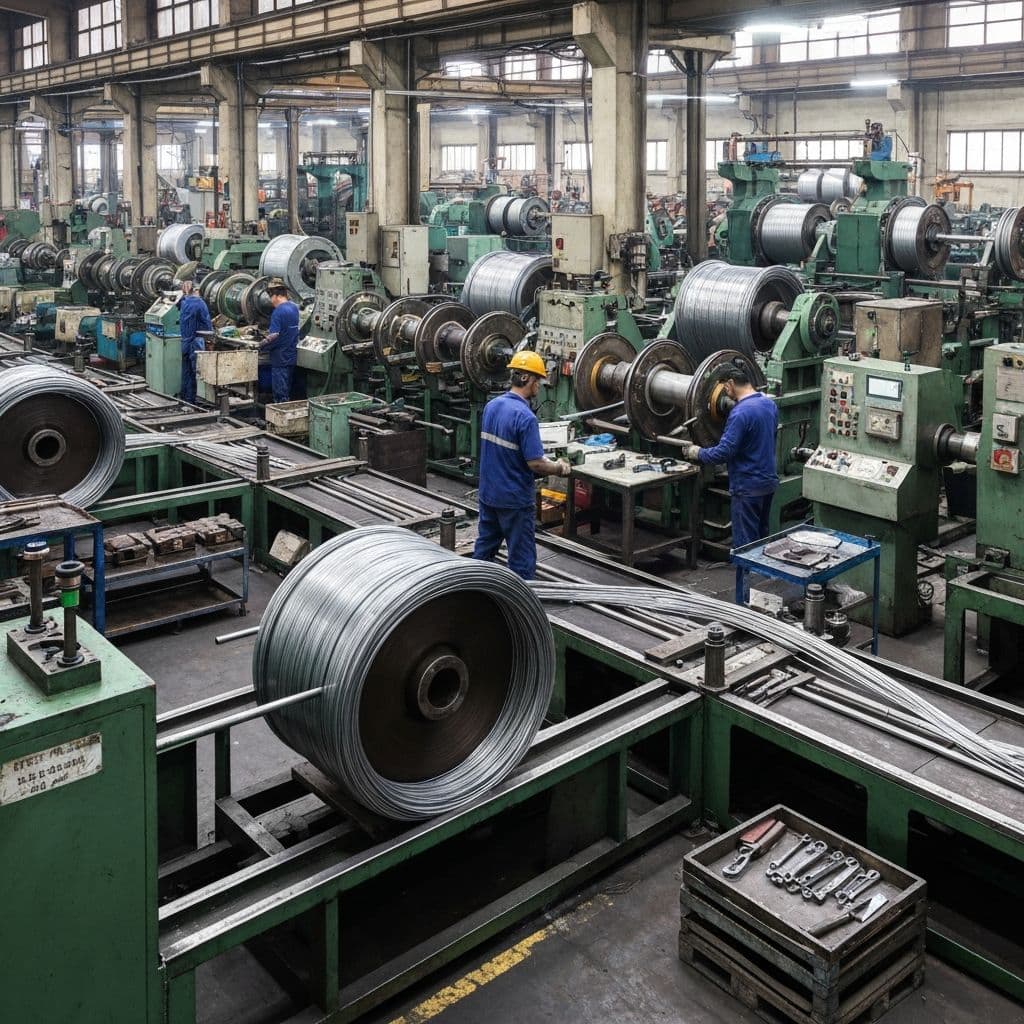
Precision drawing process: The diameter tolerance of high-end bearing steel wire must be controlled within ±0.0005mm (ordinary products are ±0.002mm), and the ovality must be less than 0.001mm. To achieve this, it is necessary to use a multi-pass progressive drawing process with diamond dies, and strictly control the drawing speed (2-3m/s) and lubrication conditions (using fully synthetic lubricating oil with viscosity grade ISO VG 100). A common mistake of low-cost suppliers is to reduce the number of drawing passes to save costs, resulting in uneven wire diameter and surface scratches, which directly reduce the fatigue life of bearings by 30%.
Heat treatment optimization: The traditional quenching-tempering process is easy to cause decarburization (decarburization layer thickness ≥0.01mm) and residual stress. High-end bearing steel wire adopts controlled atmosphere heat treatment (protective gas is nitrogen + hydrogen) and tempering at 180-220℃ for 4-6 hours, which can reduce the residual stress to less than 200MPa and the decarburization layer thickness to less than 0.003mm. Schaeffler’s 2025 Technical Report shows that after optimizing the heat treatment process, the wear resistance of bearing steel wire is increased by 25%, and the risk of brittle fracture is reduced by 70%.
3. Customized Adaptation: How Bearing Steel Wire Matches High-End Industrial Scenarios
High-end bearing steel wire is no longer a “one-size-fits-all” product, but needs to be customized according to the specific needs of different industries. The following are three typical application scenarios and their matching technical requirements, which are the key points that B2B buyers need to focus on:
Aerospace field: The bearing steel wire used in aircraft landing gear and engine bearings requires high fatigue resistance and corrosion resistance. It is usually made of high-purity martensitic stainless steel (such as 440C modified) with a tensile strength of ≥1800MPa and a corrosion resistance grade of C4 (per ASTM G48 standard). A European aerospace supplier reported that using this customized bearing steel wire can extend the service life of landing gear bearings from 5000 flight hours to 8000 flight hours.
New energy vehicle field: The bearing steel wire in the reducer and motor bearings needs to balance high wear resistance and low noise. It adopts a surface carbonitriding process, with a surface hardness of HRC 62-64 and a core hardness of HRC 45-50. This design can reduce the friction coefficient by 15-20% (down to 0.0018) and the running noise by 3-5dB. According to Ubiquitous International’s 2025 Case Study, using this customized bearing steel wire can improve the transmission efficiency of new energy vehicle reducers by 0.8% and extend the battery range by 3.2%.
High-end machine tool field: The bearing steel wire used in precision machine tool spindles requires ultra-high precision and stability. The diameter tolerance is controlled within ±0.0003mm, and the surface roughness Ra ≤0.02μm. It is usually matched with a precision grinding process to ensure that the bearing runout is less than 0.001mm, which meets the high-precision processing needs of aerospace parts and precision molds.
Performance Comparison: High-End vs. Ordinary Bearing Steel Wire
Performance Metric | High-End Bearing Steel Wire | Ordinary Bearing Steel Wire | Stainless Steel Bearing Wire | Data Source |
Fatigue Life (10⁶ cycles) | 120-150 | 50-80 | 90-110 | SKF 2026 Technical Report |
Hardness (HRC) | 60-66 | 58-62 | 58-64 | ASTM F2443-04(2021) |
Diameter Tolerance | ±0.0005mm | ±0.002mm | ±0.001mm | ISO 683-17:2018 |
Max Operating Temperature (℃) | 180 | 120 | 200 | SGS 2026 Test Report |
Oxygen Content (ppm) | ≤15 | 30-50 | ≤20 | Xingcheng Special Steel 2026 Report |
Note: All data are based on the same wire diameter (1.5mm) and test conditions (room temperature, 500rpm). Data verified by third-party testing (SGS 2026).
FAQ: B2B Buyers’ In-Depth Questions About High-End Bearing Steel Wire
Q1: Is nano-modification technology of bearing steel wire really necessary? Will it increase the cost significantly?
Nano-modification is not a “gimmick” but a necessary technology for high-end bearings. Although the upfront cost increases by 20-30%, it can reduce the bearing failure rate by 50% and the maintenance cost by 40% in the long run. For example, a German automotive bearing manufacturer switched to nano-modified bearing steel wire, and the annual maintenance cost of its gearbox bearings decreased by $68,000. In addition, with the maturity of domestic technology (such as Xingcheng Special Steel), the cost gap between nano-modified and ordinary products is gradually narrowing.
Q2: How to verify whether the bearing steel wire supplier’s material and process meet the high-end standards?
Three key verification points: First, ask for a third-party material test report, focusing on oxygen content, impurity content, and grain size (must meet ISO 683-17:2018); second, verify the precision indicators, including diameter tolerance, ovality, and surface roughness, which can be tested on-site with a micrometer and roughness meter; third, check the supplier’s cooperation cases, such as whether it has long-term cooperation with well-known bearing manufacturers (SKF, Schaeffler) or high-end equipment manufacturers.
Q3: What is the gap between domestic and imported high-end bearing steel wire? Is domestic substitution feasible?
At present, the gap between domestic high-end bearing steel wire (represented by Xingcheng Special Steel) and imported products (such as SKF, Timken) is mainly in the stability of batch production, but the core performance indicators (fatigue life, precision, hardness) have reached the international advanced level. Since 2021, Xingcheng Special Steel’s bearing steel wire has been officially used in SKF’s products, realizing domestic substitution for imports in the fields of automotive hub bearings and deep groove ball bearings. For B2B buyers, choosing domestic high-end suppliers can not only reduce the cost by 15-25% but also shorten the delivery cycle by 30%.
Technical Pitfalls to Avoid in Sourcing & Application
High-end bearing steel wire has high requirements for sourcing and application, and the following common pitfalls often lead to unnecessary losses for B2B buyers:
1. Blindly pursuing low cost: Some suppliers use ordinary steel wire to pretend to be high-end products by increasing the surface hardness, but the internal structure is uneven, leading to bearing brittle fracture. For example, a textile machinery manufacturer once used low-cost “fake high-end” bearing steel wire, resulting in 12 bearing failures in one month, with a direct loss of $35,000.
2. Ignoring the matching between wire and lubrication: High-end bearing steel wire requires matching high-performance lubricating grease (such as fully synthetic PAO grease). Using ordinary lubricating grease will reduce the wear resistance by 30% and the fatigue life by 40%. A new energy vehicle manufacturer made this mistake and had to recall 5,000 reducers, resulting in a loss of $2.1 million.
3. Neglecting post-processing inspection: The surface defects of bearing steel wire (such as micro-scratches, pits) are difficult to detect with the naked eye, but they will accelerate the bearing wear. It is necessary to use a flaw detector for 100% inspection. We have seen a precision machine tool manufacturer ignore this link, leading to a 20% reduction in the service life of the spindle bearings.
Conclusion: The Future Trend of Bearing Steel Wire in Industrial Upgrading
Bearing steel wire is the “core blood” of high-end bearings, and its technical level directly determines the performance and reliability of industrial equipment. With the upgrading of industries such as aerospace, new energy vehicles, and precision machinery, the demand for high-end bearing steel wire will continue to grow, and the future development will focus on three directions: first, more precise material modification (such as nano-composite modification) to further improve fatigue life and high-temperature stability; second, intelligent manufacturing (digital drawing, automatic heat treatment) to improve batch production stability; third, green and low-carbon production (energy-saving smelting, recyclable materials) to meet the global environmental protection requirements.
For B2B buyers, the key to selecting high-end bearing steel wire is not to pursue “high specifications” blindly, but to match the technical requirements of the application scenario, verify the supplier’s technical strength and cooperation cases, and avoid being misled by low-cost fake products. With the continuous breakthrough of domestic technology, high-end bearing steel wire will gradually realize full domestic substitution, bringing more cost-saving and efficient solutions to global industrial enterprises.