
Cold headers do not tolerate material variation. A slight out-of-roundness in the incoming wire will result in uneven cavity filling. Inconsistent surface lubrication on the wire causes premature punch wear. Wire with residual stress from improper drawing will lead to cracking at the head-to-shank transition of finished fasteners — not during manufacturing, but after installation when the joint is under load.
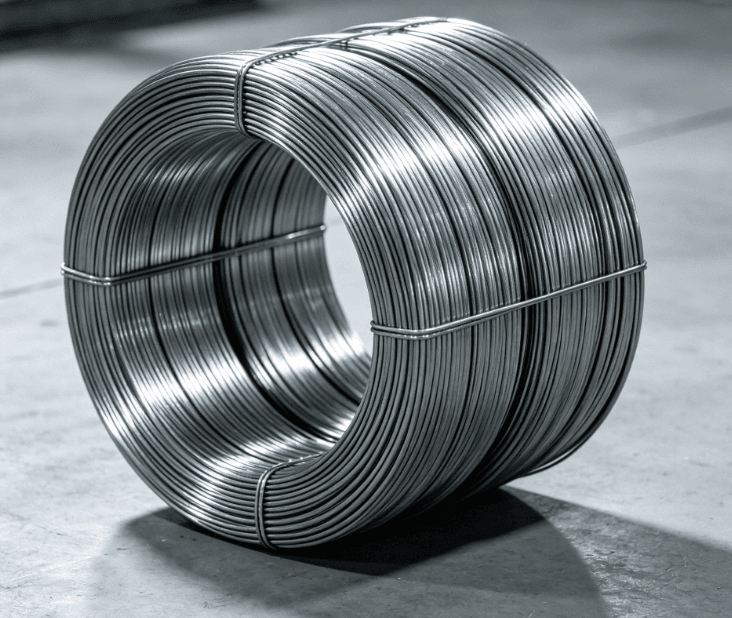
Spiral cold heading steel wire exists because standard drawn wire was fundamentally not designed for the speed and precision of modern multi-station cold headers. It is a specialized wire product produced through controlled drawing and surface treatment processes, engineered to deliver predictable material flow under extreme compressive force at production rates exceeding 200 parts per minute. The name "spiral" comes from the texture left on the wire surface by the final drawing pass. This texture optimizes lubricant retention and ensures uniform material flow into the die cavity.
For fastener manufacturers, wire is not a commodity. It is the raw material that determines die life, scrap rate, and whether a bolt can meet its nominal tensile strength after forming. Understanding what distinguishes high-quality spiral cold heading wire from general-purpose drawn wire is the line between a production line that runs consistently and one that generates continuous defects with no identifiable root cause.
What Makes Spiral Cold Heading Wire Different
Standard drawn wire is produced to dimensional tolerances. Spiral cold heading wire is produced to forming tolerances. This distinction is critical.
Cold heading subjects wire to compressive strain, and in localized areas such as fastener heads, cross-sectional area reduction can exceed 80%. Under these conditions, the wire does not simply deform — it flows. The direction and uniformity of this flow depend on the wire’s surface condition, internal residual stress distribution, and consistency of mechanical properties along its entire length. A wire that meets dimensional specifications but carries uneven residual stress from an uncontrolled drawing process will exhibit inconsistent forming behavior, producing fastener heads with variable geometry and unpredictable mechanical properties.
Spiral cold heading wire is manufactured through a multi-pass drawing process, where each diameter reduction simultaneously controls dimensional change and the resulting work hardening effect. The final drawing pass leaves a spiral texture on the wire surface, which serves a specific engineering purpose. The spiral grooves retain the phosphating or polymeric lubricant coating applied to the wire surface, ensuring lubricant is carried into the die cavity rather than scraped off at the wire guide nozzle. The spiral texture also reduces the contact area between the wire and die wall during the initial compression phase, lowering friction at the moment when forming load is highest.
Spheroidizing annealing is another key process step that sets cold heading wire apart from standard drawn wire. After drawing, the wire’s microstructure consists of elongated, work-hardened grains. If wire enters the cold header in this state, higher forming force is required, die wear accelerates, and the risk of cracking in high-deformation zones rises sharply. Spheroidizing annealing transforms the microstructure into uniformly distributed spheroidal carbide particles within a ferrite matrix. This structure deforms with minimal resistance and maximum ductility, allowing the wire to flow into complex die geometries without fracture. For medium-carbon and alloy steels used in high-strength fasteners, spheroidizing annealing is not an option — it is the process prerequisite that enables cold heading at mass production speeds.
Key Specifications That Determine Forming Performance
Cold heading wire has tighter dimensional tolerances than general-purpose drawn wire. Diameter tolerance is typically controlled within ±0.02 mm or tighter, depending on wire diameter and fastener specifications. Out-of-roundness — the difference between the maximum and minimum diameter on the same cross-section — must be controlled, because oval wire fills the die asymmetrically, causing eccentric heads and uneven flash. For high-speed multi-station cold headers producing small-diameter fasteners, out-of-roundness exceeding 0.01 mm can statistically and significantly increase scrap rates.
Surface quality affects both forming performance and the appearance of finished fasteners. Surface defects — cracks, laps, scratches, pits — act as stress concentration points during forming. Under the extreme compressive strain of cold heading, an invisible surface crack on the incoming wire can open into a full fracture through the fastener head. Surface quality is typically specified per EN 10263 or equivalent ASTM standards according to steel grade, with allowable surface discontinuity depth and frequency as acceptance criteria.
Mechanical properties in the annealed state determine how the wire responds to forming force. Tensile strength after spheroidizing annealing is generally kept relatively low — 350 to 550 MPa for medium-carbon steel — to minimize the load required for forming. A more critical indicator, however, is reduction of area, which directly measures the wire’s ductility. A reduction of area below 50% indicates insufficient or uneven spheroidization, and the wire will not flow stably under high compressive strain. For alloy steels used in Class 10.9 and 12.9 high-strength fasteners, reduction of area typically needs to exceed 55% to ensure stable forming.
Lubricant coating is an integral part of cold heading wire specifications, not an afterthought. The most common coating for carbon steel cold heading wire is zinc phosphating, which bonds chemically to the steel surface as a crystalline layer. The phosphate crystals create a micro-rough surface that anchors a second lubricant layer — usually a saponified or polymeric coating — in place during forming. Coating weight, crystal size and uniformity directly determine the coefficient of friction inside the die. For stainless steel cold heading wire, oxalate coating serves a similar function, as stainless steel cannot effectively retain a phosphate layer.
Coil condition and pay-off performance affect production efficiency in ways that do not appear on material certificates. Wire with inconsistent coiling tension will spring unevenly during uncoiling, causing feed interruptions on the cold header. Coils should be wound with controlled spiral curvature and natural set — the natural bend and spiral form of the wire when released from the coil — to ensure smooth, tangle-free pay-off. For high-volume fastener production, coil weight is typically specified between 500 and 2000 kg, depending on wire diameter and cold header consumption rate, with the goal of minimizing coil change frequency.
Common Steel Grades for Cold Heading Wire
Steel Grade | Typical Applications | Tensile Strength After Annealing | Key Characteristics |
SWRCH6A / 10B21 | Standard bolts and screws (Class 4.8–8.8) | 350–450 MPa | Good formability, widely available |
SWRCH35K / 10B38 | High-strength bolts (Class 8.8–10.9) | 450–550 MPa | Higher hardenability, strict annealing requirements |
SCM435 / 42CrMo4 | Alloy steel fasteners (Class 10.9–12.9) | 500–600 MPa | Excellent hardenability, spheroidizing annealing is critical |
304 / 316 (Austenitic) | Corrosion-resistant fasteners | 500–650 MPa | Require oxalate coating, rapid work hardening |
SWRCH22A / 10B28 | Self-tapping screws, fiberboard screws | 400–500 MPa | Balanced formability and strength |
Material Selection by Fastener Type
Wire specifications must match the forming complexity of the fastener. Simple geometries — hex bolts, double-end studs — can tolerate slightly higher tensile strength and lower ductility, as deformation is primarily axial compression. Complex geometries — flange bolts, socket head screws, parts with deep internal drive features — require maximum ductility, as material must flow laterally into thin sections and around sharp corners. For these fasteners, spheroidizing annealing quality is the most important wire characteristic.
Stainless steel cold heading wire requires additional specification considerations. Austenitic stainless steel work-hardens rapidly during forming. The wire’s initial tensile strength must be low enough to allow deformation without exceeding the capacity of the forming equipment, but the work hardening rate must be high enough to achieve the strength required for the finished fastener. For cold-formed stainless steel fasteners that receive no post-forming heat treatment, the wire’s as-annealed properties directly determine the mechanical performance of the finished part.
How to Specify Cold Heading Wire for Procurement
The minimum information required for an accurate wire supplier quotation includes: steel grade and standard, wire diameter and tolerance, surface coating type, coil weight and packaging, and intended application (fastener type and forming complexity). This last point — what the wire will actually be used for — allows the supplier to tailor annealing and surface treatment processes to the forming requirements.
For critical fasteners, include reduction of area requirements in the specification. For fasteners with complex head geometry, specify that spheroidizing annealing be optimized for maximum cold formability, not minimum tensile strength. For stainless steel fasteners, note the coating type and whether post-forming heat treatment is planned, as this affects the required as-annealed properties.
A wire supplier that asks about your fastener type, forming equipment and production speed before quoting is applying their process knowledge to your application. A supplier that quotes based solely on diameter and grade is selling general-purpose wire, not cold heading wire. This difference ultimately shows up in die life, scrap rate, and whether the production line can run an entire shift without downtime.
Frequently Asked Questions
Q: What is the difference between cold heading wire and standard drawn wire?
A: Cold heading wire undergoes spheroidizing annealing to maximize ductility, features a surface coating optimized for forming lubrication, and is produced to tighter dimensional tolerances than standard drawn wire. Standard drawn wire is designed for general manufacturing processes and will not flow stably under the extreme compressive strain of cold heading.
Q: Why is spheroidizing annealing so important for cold heading?
A: Spheroidizing annealing transforms the wire’s microstructure into spheroidal carbide particles distributed within a soft ferrite matrix, providing maximum ductility and minimum forming resistance. Without this step, medium-carbon and alloy steel wire requires higher forming force, causes faster die wear, and is prone to cracking in high-deformation zones.
Q: How is the spiral surface texture created, and why does it matter?
A: The spiral texture is produced during the final drawing pass. It retains phosphating or polymeric lubricant coatings on the wire surface. Without it, lubricant would be scraped off at the die opening, increasing friction and forming load. The spiral texture also reduces the contact area between the wire and die during the initial compression phase.
Q: What coil weight should be specified for high-volume fastener production?
A: A coil weight of 500 to 2000 kg is the standard range, depending on wire diameter and cold header consumption rate. Heavier coils reduce change frequency but require compatible uncoiling equipment. The goal is to match coil weight to production batch length and minimize downtime.
Summary
Spiral cold heading steel wire is a specialized product built for one purpose: to flow stably and predictably under the extreme compressive force of high-speed multi-station cold headers. The metrics that determine its ability to perform this function go far beyond diameter and tensile strength. They include the quality of spheroidizing annealing that provides the ductility to fill complex die cavities, the surface coating that carries lubricant into the forming zone, the dimensional consistency that ensures symmetrical die filling, and the coil condition that keeps the production line running without interruption.
For fastener manufacturers, wire is the first link in a chain that ends with a bolt holding a structure in place. When something goes wrong at this link — a crack that opens after installation, an eccentrically formed head, a thread that strips under load — the root cause is rarely traced back to the wire. The blame falls on the dies, the operator, or the machine parameters. But the wire that flows unevenly, that work-hardens unpredictably, that carries its residual stress into the die — that is the root cause. Treating cold heading wire as a commodity will cost more in dies, scrap and downtime than the price difference between standard wire and wire purpose-built for cold forming.