
Introduction
Screw wire—the raw material that becomes the billions of fasteners holding our world together—has traditionally been seen as a commodity. Steel wire rod, drawn down to precise diameters, heat-treated, and formed into screws, bolts, and nuts. It's a mature industry, and for decades, the changes were incremental at best.
That's no longer the case.
The screw wire industry is undergoing a transformation driven by three converging forces: demand for higher performance, pressure for sustainability, and the integration of digital manufacturing technologies. The global cold heading wire market was valued at USD 20.3 billion in 2024 and is estimated to grow at a CAGR of 4.4% to reach USD 31 billion by 2034. The broader steel wire market is projected to grow from USD 115.68 billion in 2024 to USD 188.76 billion by 2033. These aren't modest numbers—they reflect fundamental shifts in how screw wire is specified, manufactured, and applied.
This article explores the key innovations reshaping screw wire production: advanced materials, manufacturing process improvements, sustainable solutions, and the digital transformation of the supply chain.
Advanced Materials: Beyond Conventional Steel
The traditional screw wire landscape was dominated by carbon steel, alloy steel, and stainless steel. Carbon steel alone accounted for over USD 9.7 billion in revenue in 2024 and is forecast to reach USD 14.5 billion by 2034. But the material palette is expanding rapidly.
High-Strength Alloys
High-strength screw wire is a special steel or alloy material used to produce high-strength screws, offering excellent tensile strength, corrosion resistance, and wear resistance to withstand high loads and harsh environments. Through specialized heat treatment processes, these wires achieve improved hardness and toughness, ensuring reliability and stability in demanding applications.
The aerospace sector is driving particularly aggressive specifications. The new European standard prEN 3833:2025 covers screws made from high-temperature resistant nickel-base alloy NI-PH2601 (Inconel 718), with a strength class of 1550 MPa at room temperature and 650°C operating capability. This isn't niche—it's becoming the benchmark for high-performance fasteners.
ASTM F2882/F2882M-17(2025) now specifies quenched and tempered alloy steel screws with a minimum ultimate tensile strength of 170 KSI (approximately 1,172 MPa). These are not experimental grades—they're codified standards that manufacturers must meet.
Titanium Alloys
Titanium screw wire is emerging as a critical material for high-end applications. The global high-end titanium wire market was expected to reach approximately USD 1.2 billion in 2025. The entire titanium alloy market, including various wire forms, is projected to reach approximately USD 5.4 billion in 2025, with a compound annual growth rate of 6.8%.
A striking example of this trend is in consumer electronics. A single batch of titanium wires was used to manufacture the crucial screws inside Apple mobile phones—each phone requires precisely 28 screws made from these titanium wires, with extremely strict requirements for strength, lightweight, corrosion resistance, and dimensional accuracy.
Titanium wire is also widely used in medical applications, including surgical implants such as bone nails, screws, and joint replacements, benefiting from excellent biocompatibility. The European standard EN 4800-004:2025 now specifies requirements for titanium and titanium alloy wire, reflecting the growing standardization of these materials.
Copper Alloys
Copper alloys are finding renewed relevance in screw wire applications, particularly where electrical conductivity and corrosion resistance are required. New European standard EN 12166:2025 specifies composition, property requirements, and dimensional tolerances for copper alloy wire intended for general purposes, spring, and fastener manufacturing applications.
Research is pushing the boundaries further. A Cu-6.5Fe-0.3Mg-0.1Si alloy wire, designed and fabricated through thermo-mechanical treatment, achieved an impressive tensile strength of 1,210 MPa in the cold-drawn state, accompanied by an electrical conductivity of 47.1% IACS. After annealing, the values were 835 MPa and 61.67% IACS. The heterogeneous deformation-induced strengthening (HDI) between the copper matrix and iron fibers contributed 57.5% and 47.9% to the overall strength before and after annealing, respectively.
Cu-Cr-Zr alloys are considered ideal materials for high-speed rail contact lines due to their exceptional electrical conductivity and mechanical strength—and similar properties make them valuable for specialized fastener applications.
Nickel Alloys
The global nickel alloys market stood at USD 17.6 billion in 2025 and is forecast to reach USD 33.3 billion by 2035, expanding at a CAGR of 5.5%. Nickel alloy wires alone represented USD 426.34 million in 2025, projected to reach USD 573.23 million by 2032.
These materials are critical for fasteners in chemical processing, offshore oil and gas, and high-temperature industrial applications where corrosion resistance and thermal stability are non-negotiable.
Aluminum Alloys
Aluminum alloys with scandium (AlSc) represent a strategic material alternative to copper wiring, offering a blend of lightweight strength, corrosion resistance, and tunable conductivity. Alloying aluminum wires with scandium significantly improves tensile strength to 200–210 MPa and corrosion resistance. These properties make AlSc alloys attractive for lightweight fastener applications in aerospace and automotive sectors.
Manufacturing Innovations
Wire Drawing Advancements
Wire drawing remains the foundational process for screw wire production, but the technology is evolving.
A significant development is the installation of new single-block wire drawing machines capable of processing low-carbon steel wire rod and cold heading quality wire up to Ø 22 mm. This marks a significant increase in size capacity, designed to support more complex manufacturing operations. The horizontal-axis single-block configuration ensures continuous and precise processing even with large diameters, improving stability and maintaining tight tolerances and uniform surface finish.
Drawn wire is now available in various surface finishes: phosphated, bright pickled, or coated with polymer films for special applications. Packaging is also customized—material can be supplied on spools or in coils, depending on logistics requirements or the feeding system of the customer's equipment.
Cold Heading and Forming
Cold heading—the process of forming screw heads at room temperature using immense pressure—continues to be the dominant manufacturing method for fasteners. The process creates a continuous internal "flow line" that follows the shape of the screw, resulting in superior shear strength.
The evolution of cold and warm forming is a key focus area for major equipment manufacturers. Carlo Salvi S.p.A. and Hatebur Umformtechnik AG have strengthened their role as technology partners in the processing of wire in alloys and superalloys, with their 2026 innovation strategy focusing on three main directions, including the evolution of cold and warm forming technologies.
Heat Treatment Innovations
Heat treatment is critical for achieving the mechanical properties required in high-performance fasteners. Innovations in this space are focused on reducing energy consumption while improving consistency.
Chinese steel mills are pioneering the use of non-quenched and tempered steel and annealing-free wire rods, reducing heat treatment energy consumption from the source and helping the entire fastener chain achieve a 30% carbon reduction. This is a significant development—heat treatment is one of the most energy-intensive steps in screw wire processing.
Sustainability: The New Imperative
Green Materials
Sustainability is no longer a marketing talking point—it's a procurement requirement.
Steel manufacturers are developing low-carbon product series from the design stage, including high-strength, high-corrosion-resistance, high-fatigue, high-temperature carburizing, cold-working, non-quenched and tempered, and annealing-free steel grades. These innovations are driven by both regulatory pressure—particularly the approaching implementation of the EU Carbon Border Adjustment Mechanism (CBAM)—and customer demand.
Eco-Friendly Coatings
Surface treatments are also going green. Phosphate-free galvanization and advanced zinc alloys are reducing environmental impact without compromising corrosion resistance. Eco-friendly coatings that comply with stringent environmental regulations without compromising performance are becoming standard.
Some manufacturers are developing woodscrews coated with an additional layer of varnish, delivering enhanced corrosion resistance even in challenging environments while maintaining a focus on sustainable materials.
Market Drivers
The shift toward sustainability is not optional. Manufacturers are integrating life-cycle assessments into material selection and leveraging eco-friendly coatings to meet evolving regulatory requirements and capture value from environmentally conscious end users. Sustainability mandates have propelled the use of eco-friendly coatings that reduce environmental impact without compromising corrosion resistance.
Digital Transformation and Automation
Industry 4.0 Integration
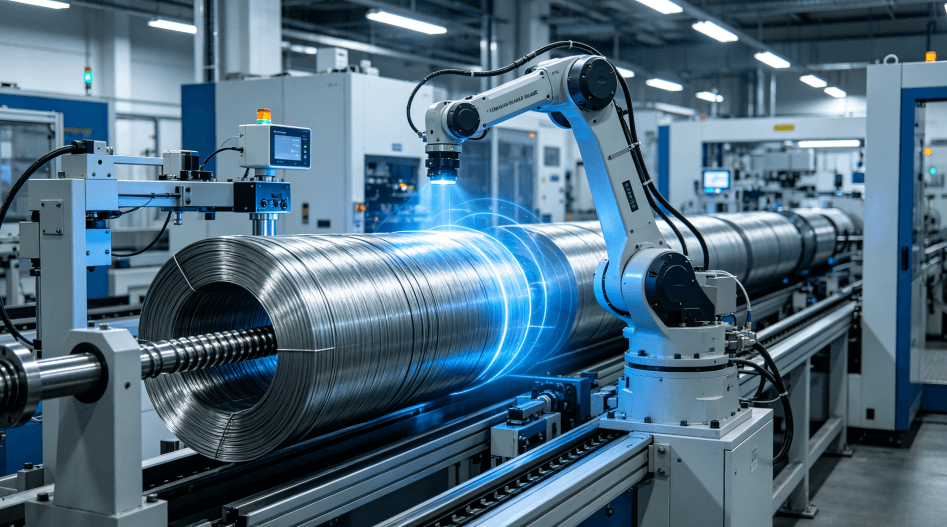
The screw wire industry is embracing digital manufacturing technologies. Fully automatic screw production lines now integrate key processes including wire drawing, cold heading, thread rolling, polishing, heat treatment, and surface galvanization. Automatic cold heading machines efficiently form screw heads by cold forging, supporting various head types with fast forming speed and high precision.
Automated Assembly Systems
The automated screwdriving and fastening system market was valued at USD 2.5 billion in 2024 and is projected to reach USD 5.8 billion by 2034, registering a CAGR of 8.9%. This growth reflects the increasing integration of fasteners into automated production lines, where precision and consistency are paramount.
In 2025, the adoption of threaded inserts in automation and robotics accelerated at an unprecedented pace, with engineers across manufacturing, aerospace, and automotive sectors increasingly turning to wire thread inserts to enhance efficiency, precision, and sustainability in automated assembly processes.
Supply Chain Resilience
Global crises and fragile supply chains are forcing fastener manufacturers to rethink sourcing strategies, accelerating the shift toward in-house production. This trend is driving investment in domestic manufacturing capabilities and reducing dependence on single-source suppliers.
Market Outlook
The screw wire and fastener markets are positioned for sustained growth. The global steel wire rod market is projected to reach USD 149.96 billion by 2032, with a CAGR of 3.22%. The industrial fasteners market is expected to grow from USD 88.38 billion in 2025 to USD 113.21 billion by 2031 at 4.21% CAGR. The metal screw fastener market is projected to reach USD 34.31 billion by 2034.
Regional dynamics are shifting. The US steel wire market was estimated at USD 31.8 billion in 2024, while China is projected to reach USD 45.2 billion by 2030 with a CAGR of 10.7%. This rapid growth in Asia reflects both manufacturing expansion and infrastructure investment.
A Real-World Application
The use of titanium screws in consumer electronics is a compelling example of how material innovation is driving change. Each Apple phone requires precisely 28 screws made from titanium wire, with extremely strict requirements for strength, lightweight, corrosion resistance, and dimensional accuracy. This isn't a niche application—it represents a fundamental shift in how electronics manufacturers think about fasteners, driving demand for higher-performance screw wire across the entire supply chain.
Similarly, in the aerospace sector, the specification of Inconel 718 for high-temperature fasteners (prEN 3833:2025) demonstrates how regulatory standards are codifying performance requirements that push the boundaries of screw wire technology.
FAQ
Q: What is driving innovation in screw wire materials?
A: Three main factors: demand for higher performance in aerospace, automotive, and electronics; pressure for sustainability and reduced carbon footprint; and the integration of digital manufacturing technologies. High-strength alloys, titanium, and advanced copper alloys are all seeing increased adoption.
Q: How is sustainability affecting screw wire manufacturing?
A: Steel mills are developing non-quenched and tempered steel and annealing-free wire rods that reduce heat treatment energy consumption by up to 30%. Eco-friendly coatings like phosphate-free galvanization are becoming standard. The EU Carbon Border Adjustment Mechanism is accelerating this shift.
Q: What are the key trends in screw wire manufacturing technology?
A: Larger-diameter wire drawing capabilities (up to Ø 22 mm), fully automatic production lines integrating all key processes, and the evolution of cold and warm forming technologies for alloys and superalloys. Automation and Industry 4.0 integration are also major trends.
Q: Which materials are replacing conventional steel screw wire?
A: Titanium alloys for lightweight high-strength applications, nickel alloys for high-temperature and corrosive environments, copper alloys for applications requiring electrical conductivity, and aluminum-scandium alloys for lightweight structural fasteners.
Q: How large is the screw wire market?
A: The cold heading wire market was valued at USD 20.3 billion in 2024 and is projected to reach USD 31 billion by 2034. The broader steel wire market is projected to reach USD 188.76 billion by 2033.
Final Thoughts
The screw wire industry is not what it was a decade ago. The commodity mindset—where screw wire was specified primarily by diameter and carbon content—is being replaced by a performance-driven approach that considers material science, manufacturing precision, environmental impact, and supply chain resilience.
High-strength alloys, titanium, copper alloys, and nickel alloys are expanding the performance envelope. Cold heading and wire drawing technologies are becoming more capable and more precise. Sustainability is moving from a differentiator to a requirement. And digital manufacturing is transforming how screw wire is processed and how fasteners are assembled.
The future of screw wire is not about doing the same thing slightly better. It's about rethinking what's possible—and then building the supply chain to deliver it.