
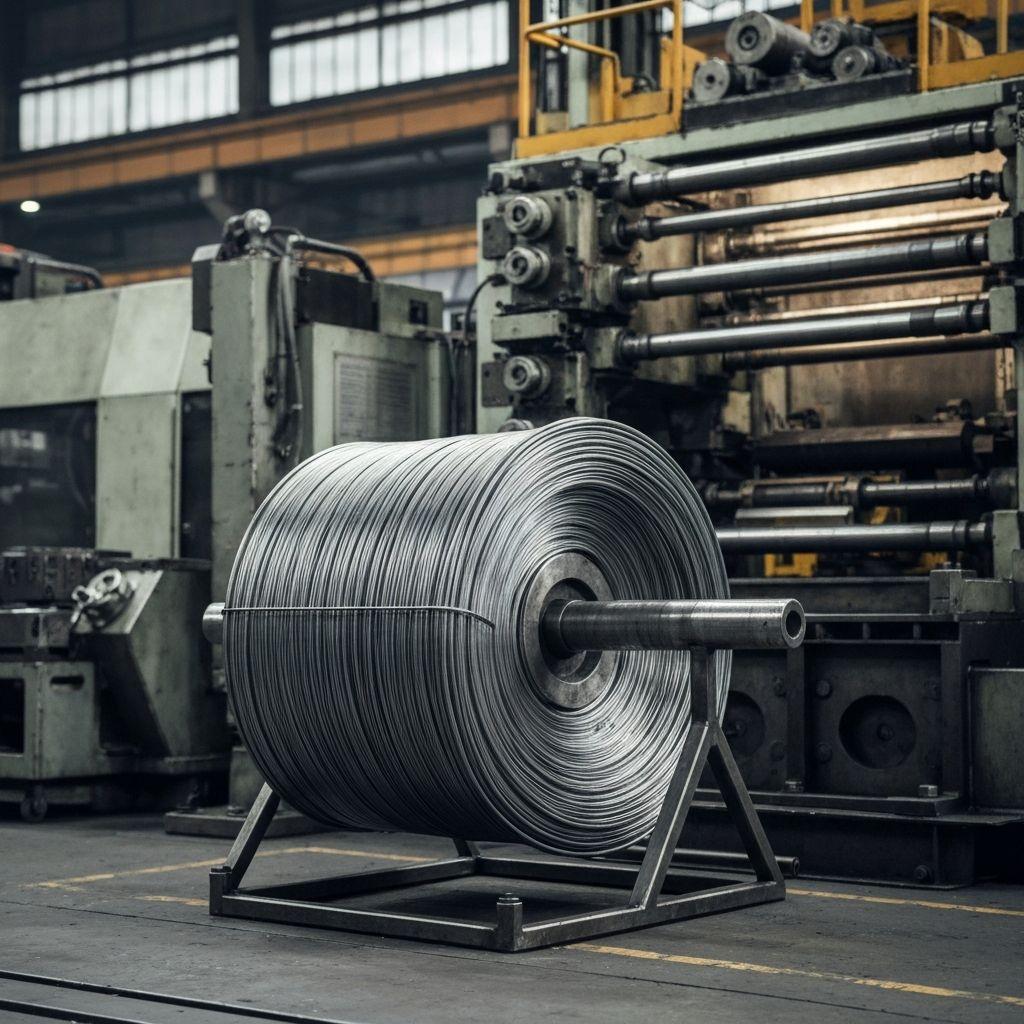
What spring steel wire is and where the specification starts
Spring steel wire is a cold-drawn or oil-tempered steel wire intended to store and release elastic energy in springs, clips, retainers, and other elastic machine elements. The purchasing specification is not one number. It is a set of coupled conditions: steel grade, wire diameter and tolerance, condition (drawn, annealed, oil-tempered), tensile strength or hardness range, surface condition, and allowable decarburization. Change any one and the spring's fatigue life or formed shape can move.
For buyers, the useful starting point is the spring's duty cycle, not the wire catalog. A compression spring cycling millions of times in a transmission and a one-time-formed retaining clip do not need the same wire condition. This guide explains the mechanism behind each decision factor, the failure modes to inspect for, and the verification steps that belong in a purchase order.
How spring steel wire is made, and why the process matters to buyers
Most spring wire follows one of two routes. In the cold-drawn route, hot-rolled wire rod is descaled, coated, drawn through successively smaller dies, and usually patented or annealed between draws to restore ductility. The final drawing pass sets diameter and raises strength through work hardening. In the oil-tempered route, the wire is drawn to size, then continuously austenitized, quenched, and tempered to a specified strength range. Oil-tempered wire is common where the spring will be formed and given only a low-temperature stress relief rather than a full hardening cycle.
Each step leaves a signature that a buyer can test. Drawing lubricant and coating residues affect friction and coating adhesion. Die condition affects surface roughness and the depth of surface defects. Patenting and tempering control the carbide distribution and the balance between strength and ductility. That is why two suppliers quoting the same grade and diameter can deliver wire that forms differently.
The wire condition must also match the springmaker's process. If the spring will be austenitized and quenched after coiling, the wire's incoming strength matters less than its chemistry and cleanliness. If the spring is coiled and stress-relieved only, the incoming tensile strength and surface quality carry most of the fatigue performance.
Matching steel grade to the spring's duty
Carbon spring steels are the default for general mechanical springs. Higher carbon content raises achievable strength and fatigue resistance but reduces ductility and tolerance for surface defects. Alloying elements such as chromium, manganese, silicon, and vanadium shift hardenability, temper resistance, and sag resistance. Stainless grades are selected when corrosion resistance or non-magnetic behavior is required, at the cost of lower achievable strength in many conditions.
Rather than name a grade in isolation, specify the grade together with the condition and the property range you will accept. A grade name alone does not define tensile strength, surface quality, or decarburization depth.
| Selection driver | What it changes in the wire | Procurement implication |
|---|---|---|
| Fatigue-dominated duty (millions of cycles) | Surface quality and decarburization control become critical | Specify surface defect limits and decarburization depth; request inspection records |
| Static or low-cycle duty | Strength and set resistance dominate over surface finish | Focus on tensile/hardness range and stress-relief compatibility |
| Corrosive environment | Stainless or coated wire replaces plain carbon | Confirm coating or grade with corrosion test data, not just a label |
| Forming-intensive geometry (tight index, sharp bends) | Ductility and bend performance matter more than peak strength | Ask for bend or wrap test results at the ordered diameter |
| Elevated-temperature service | Temper resistance and sag resistance govern | Confirm the tempering temperature used and the expected service temperature |
If your application also involves bearing components, note that spring wire and bearing wire are specified differently. Bearing steel wire such as GCr15 is selected for through-hardened rolling contact fatigue and cleanliness, while spring wire is selected for elastic energy storage and fatigue under bending or torsion. Do not substitute one for the other without engineering review.
Diameter, tolerance, and tensile strength: the coupled variables
Spring rate scales strongly with wire diameter, so diameter tolerance is a functional requirement, not a cosmetic one. A wire at the top of its tolerance band can produce a spring rate outside the design window, and the effect compounds across a batch.
Tensile strength in cold-drawn wire rises as diameter falls, because smaller wire receives more total reduction. That means a tensile range quoted for one diameter cannot be assumed for another. When comparing quotes, require the tensile or hardness range at the ordered diameter, plus the test method and sampling frequency.
There is also a trade-off inside the strength range. Running at the top of the allowable tensile range can improve set resistance but reduce ductility and increase the risk of coiling cracks in tight geometries. Buyers should state the acceptable range and let the spring design, not the mill's default, set the target.
Diameter measurement itself needs definition. Agree whether diameter is measured with a micrometer at multiple positions along the coil, how ovality is handled, and whether the tolerance applies to individual readings or to a lot average. Vague agreement here is a common source of incoming-inspection disputes.
Surface condition and decarburization: where fatigue failures begin
Springs usually fail in fatigue, and fatigue cracks usually start at the surface. Surface defects act as stress concentrators: drawing marks, seams, pits, and scratches each raise local stress. Decarburization, a loss of carbon near the surface during hot processing, lowers surface strength and fatigue resistance even when the core meets specification.
Specify decarburization as a maximum depth, measured by metallographic examination on a defined number of samples, and state whether partial decarburization is counted. Also specify the acceptable surface condition: no seams, cracks, or harmful pits, with a defined roughness where coating adhesion or fatigue matters.
Coating and lubrication are part of surface condition. Phosphate or polymer coatings affect drawing friction and corrosion protection, while residual lubricant can interfere with subsequent coating or heat treatment. Ask what coating is applied, how it is removed before heat treatment if applicable, and how coating weight or thickness is verified.
Inspection and verification plan for incoming spring wire
A practical verification plan tests the properties that the spring process actually depends on. The table below maps each check to the decision it supports.
| Check | Method (typical) | Decision it supports |
|---|---|---|
| Diameter and ovality | Micrometer or laser gauge at defined positions | Accept lot against spring-rate tolerance |
| Tensile strength or hardness | Tensile test or hardness test per agreed standard | Confirm condition and strength range at ordered diameter |
| Surface defects | Visual and magnified inspection; dye penetrant where agreed | Screen for seams, cracks, and harmful pits |
| Decarburization depth | Metallographic cross-section | Confirm surface integrity for fatigue duty |
| Bend or wrap test | Wrap around a mandrel of defined diameter | Confirm ductility for forming |
| Coating condition | Visual, coating weight, or adhesion test | Confirm corrosion protection and downstream compatibility |
| Chemistry | Spectrochemical analysis | Verify grade identity |
Sampling frequency should be agreed in writing. A certificate of analysis is useful, but it is a record of the mill's test, not a substitute for your own incoming checks. For critical springs, retain samples from each lot so a field failure can be traced back to wire condition.
Common failure modes and what they indicate
- Coiling cracks or breakage during forming. Usually points to ductility at the low end, surface defects, or a tensile strength above the forming window. Check bend test results and surface condition before blaming the spring design.
- Spring rate out of specification. Often a diameter tolerance or modulus issue. Verify diameter distribution across the lot, not just the certificate value.
- Early fatigue failure at the surface. Look for decarburization, seams, or pits. Metallographic cross-sections and fracture-origin inspection are the diagnostic steps.
- Loss of load over time (sag). Relates to tempering and stress-relief practice. Confirm the wire's tempering condition and the springmaker's stress-relief cycle.
- Corrosion or coating failure. Check coating type, thickness, and handling damage; confirm the wire grade matches the environment.
Each failure mode maps to a purchase-order clause. If a clause is missing, the failure becomes a debate rather than a nonconformance.
Supplier verification questions before you place an order
Ask these questions and require documented answers. The goal is to confirm that the supplier can hold the specification repeatedly, not just once.
- Which steel grade and wire condition will you supply, and what is the tensile or hardness range at our ordered diameter?
- What is the maximum decarburization depth, and how is it measured and sampled?
- What surface defect limits apply, and what inspection method is used?
- What diameter tolerance applies to individual readings, and how is ovality handled?
- What coating or lubricant is applied, and how is it verified?
- Can you provide lot traceability from wire rod to finished coil?
- What is your change-notification process if the steel source, drawing route, or coating changes?
For buyers sourcing related precision components, the same discipline applies to bearing steel wire and precision needle rollers: define the property, define the test, and define the sampling. A supplier that can answer these questions precisely is easier to qualify than one that answers with general assurances.