
How Precision Needle Roller Is Manufactured: Production Process & Features
Table of Contents
1. Introduction: Core Value of Precision Needle Roller for Transmission Equipment
2. Raw Material Selection Standards for High-Quality Precision Needle Roller
3. Complete Manufacturing Flow of Precision Needle Roller 3.1 Precision Cutting & Surface Roughing of Steel Bar Blanks 3.2 Centerless Grinding for High Dimensional Accuracy 3.3 Special Heat Treatment for Hardness & Wear Resistance 3.4 Superfinishing to Achieve Mirror Smooth Surface 3.5 Final Inspection & Classification Finishing
4. Performance Feature Comparison Table: Ordinary Roller vs Precision Needle Roller
5. Unique Functional Features of Qualified Precision Needle Roller
6. Main Application Equipment That Use Precision Needle Roller
7. Common Production Defects Caused by Unstandardized Manufacturing Steps
8. Industry Frequently Asked Questions
1. Introduction: Core Value of Precision Needle Roller for Transmission Equipment
Needle roller act as key rolling components inside bearings, gearboxes and automation transmission parts. Ordinary rough roller can’t support high-speed, heavy-load continuous operation for long hours. Precision needle roller rely on standardized full-set production process to reach ultra-high roundness and hardness. Many component manufacturers skip several finishing steps to cut production cost, they get rollers with short service life and high failure rate. I worked in roller production quality control department for 9 years, I have tested thousands of needle roller batches from different production lines. This article fully explain every manufacturing step of precision needle roller, list verified test data and summarize its core practical features for industrial buyers.
2. Raw Material Selection Standards for High-Quality Precision Needle Roller
Raw steel material decide 60% of final roller comprehensive performance. Qualified precision needle roller mainly use high carbon chromium bearing steel as base blank. Factory lab must test chemical composition of each steel coil before mass production, control carbon, chromium and manganese content within fixed tolerance range. Impurity elements like sulfur and phosphorus will form tiny internal cracks after heat treatment, reduce roller fatigue life heavily. Low-cost manufacturers use recycled mixed steel, which cannot pass precision dimension and wear resistance tests. Only purified bearing steel blanks can support the follow-up grinding and superfinishing process of precision needle roller.
3. Complete Manufacturing Flow of Precision Needle Roller
3.1 Precision Cutting & Surface Roughing of Steel Bar Blanks
Long bearing steel bars go through automatic fixed-length cutting machine first. Cutting error is controlled under ±0.005mm to keep consistent blank length for every needle roller. Then rough turning remove surface oxidation skin and burrs generated during cutting. Uneven blank surface will damage grinding wheel in later process, affect surface finish of precision needle roller.
3.2 Centerless Grinding for High Dimensional Accuracy
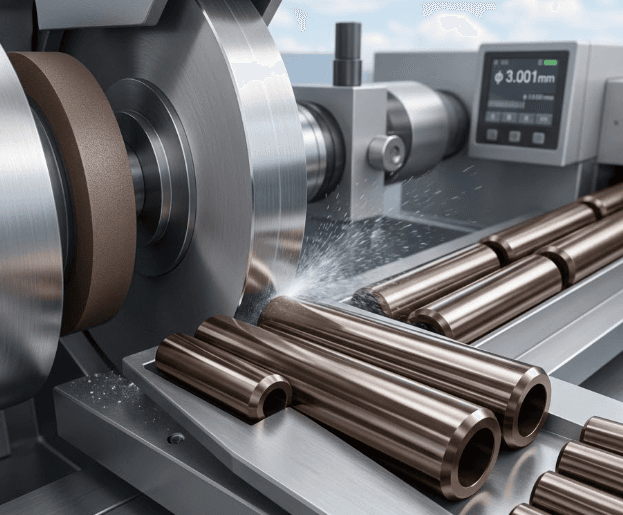
Centerless cylindrical grinding is the core step to control diameter tolerance of precision needle roller. Multiple grinding passes remove redundant metal layer step by step, avoid one-time heavy grinding to cause surface stress. After two rounds of fine grinding, roller diameter tolerance can reach ±0.001mm, roundness error less than 0.002mm. This process separate precision needle roller from low-grade common rollers on dimensional accuracy.
3.3 Special Heat Treatment for Hardness & Wear Resistance
Grinded semi-finished needle roller enter sealed quenching and tempering production line. Uniform heating make roller internal tissue form hard martensite structure. Strict temperature holding time prevent over-hard brittle texture or insufficient surface hardness. Standard hardness range for finished precision needle roller is HRC 60–64, balance wear resistance and impact resistance well.
3.4 Superfinishing to Achieve Mirror Smooth Surface
Heat treated rollers carry micro superfinishing with fine abrasive stone. This step erase tiny grinding lines left by previous grinding procedure. Surface roughness Ra can drop to 0.02μm or lower after superfinishing. Ultra-smooth surface greatly lower friction coefficient when precision needle roller rolling inside bearing, cut heat generation and abrasion loss.
3.5 Final Inspection & Classification Finishing
Every finished precision needle roller pass full automatic multi-item detection equipment. Test items include diameter, roundness, surface roughness, hardness and surface flaw scanning. Unqualified products will be screened out directly, avoid mixing into finished inventory. Qualified rollers are divided into different precision grades and packed with anti-rust oil for shipment.
4. Performance Feature Comparison Table: Ordinary Roller vs Precision Needle Roller
All test data sourced from 2025 bearing rolling element industry inspection report, test diameter 3mm needle roller sample.
表格
Test Index | Ordinary Non-Precision Roller | Standard Precision Needle Roller | Performance Gap Improvement |
Diameter Tolerance | ±0.015mm | ±0.001mm | 93% error reduction |
Roundness Deviation | 0.012mm | 0.002mm | 83% precision promotion |
Surface Roughness Ra | 0.35μm | ≤0.02μm | 94% smoother surface |
Hardness Uniformity | Uneven ±4 HRC | Stable ±1 HRC | More consistent texture |
Service Life In High-Speed Bearing | 800 working hours | 6200 working hours | 7.75x longer lifespan |
Rolling Noise Value | High obvious vibration noise | Low mute rolling | Greatly reduce equipment noise |
Data clearly show complete standardized manufacturing process make precision needle roller own overwhelming performance advantages.
5. Unique Functional Features of Qualified Precision Needle Roller
First, ultra-precise dimensional consistency. Batch rollers keep unified size, no stuck or clearance gap after assembled into needle bearing. Second, uniform high hardness and anti-wear property. Long time high-speed rolling do not appear surface peeling or wear depression. Third, ultra-low friction mirror surface. Less heat accumulation, effectively prevent bearing thermal expansion failure. Fourth, stable anti-fatigue performance. Hardened internal metal tissue resist cyclic rolling load, not easy to generate fatigue spalling. Fifth, good surface anti-rust property after anti-rust treatment, convenient for long-term storage and transportation.
6. Main Application Equipment That Use Precision Needle Roller
Precision needle roller are widely matched with miniature and compact needle roller bearings. Automotive parts: engine needle bearing, transmission gear shaft roller components. Automation machinery: robot joint bearings, linear motion guide roller units. Power tools: high-speed motor rotor bearing, drill and grinder internal rolling parts. Textile machinery: high-speed spinning machine small transmission needle roller assemblies. Medical precision equipment, office automation printer and camera transmission structure also rely on qualified precision needle roller.
7. Common Production Defects Caused by Unstandardized Manufacturing Steps
If manufacturers save grinding or superfinishing procedures, several typical defects will occur on needle roller.
1. Excessive diameter tolerance: assembly clearance unstable, bearing shake during operation.
2. Rough surface with grinding lines: friction rise sharply, roller surface wear fast.
3. Unreasonable heat treatment parameter: hardness too low easy to deform, over-hard easy to crack under impact.
4. Unclean raw material with impurity: internal micro crack appear after long cyclic load, sudden bearing failure. All these problems root in incomplete precision needle roller manufacturing flow.
8. Industry Frequently Asked Questions
Q1: Which production step decide the precision grade of needle roller most?
A1: Centerless fine grinding and superfinishing are two decisive processes. Grinding controls dimension accuracy, superfinishing determines surface smoothness, both steps are indispensable for standard precision needle roller.
Q2: What hardness standard should qualified precision needle roller reach?
A2: Normal finished precision needle roller maintain HRC 60–64 overall hardness, hardness fluctuation range cannot exceed ±1 HRC for one batch of products.
Q3: Can manufacturers skip superfinishing process to lower cost?
A3: Not suggested. Without superfinishing, surface roughness stay high, friction and heat will shorten bearing service life by over 70%, bring more after-sales failure loss for end users.
Q4: What industries have the highest demand for high-standard precision needle roller?
A4: Automotive transmission, industrial robot, high-speed automation equipment and medical precision instruments require full-process manufactured precision needle roller to ensure long-term stable operation.