
Table of Contents
Why a Component the Diameter of a Pencil Lead Matters More Than Ever
The Geometry That Makes Needle Rollers Indispensable in EV Transmissions
Micron-Level Precision: Where Efficiency Actually Comes From
The Silence Problem: Why EV Transmissions Expose Bearing Noise Like Never Before
Cage Design: The Acoustic Architect Inside the Bearing
Material and Surface Engineering: DLC, Carburizing, and Coatings
Supplier Landscape and Sourcing Considerations
The Cost of Precision: A Procurement Framework
Frequently Asked Questions
Final Word
1. Why a Component the Diameter of a Pencil Lead Matters More Than Ever
An EV transmission is a fundamentally different animal from the step-ratio automatic gearbox that dominated the last seventy years of automotive engineering. There is no torque converter, no clutch pack the size of a dinner plate, and — crucially — no internal combustion engine drowning out every mechanical sound within a ten-foot radius. The electric motor spins to 18,000, sometimes 25,000 rpm, and the only thing between that motor and the wheels is a compact reduction stage, often a planetary gearset, supported by bearings small enough to fit inside the planet gears themselves.
That space — the annulus between a planet gear bore and its supporting pin — is where the needle roller bearing lives. A typical e-axle planetary stage might carry three to five planet gears, each with its own set of needle rollers. The entire bearing assembly might have a cross-sectional height of 2 to 4 mm, yet it must transmit torque loads that can exceed 300 N·m at the motor output shaft, handle angular misalignment from helical gear thrust, survive oil-film conditions that are getting thinner as lubricant viscosity drops in pursuit of efficiency, and do all of this while generating noise levels low enough that a driver accelerating onto a highway hears nothing except maybe a faint whine from the inverter.
If the needle rollers in that planet gear are not right — if the diameter tolerance wanders, if the surface finish is a grade too coarse, if the cage geometry allows roller skewing — the transmission efficiency drops by a fraction of a percent. In a world where OEMs fight over every kilometer of range, that fraction matters.
The global needle roller bearing market was valued at approximately USD 4.93 billion in 2024 and is projected to reach USD 5.27 billion in 2025, growing at a CAGR of roughly 7.0%. Within the automotive segment specifically, the EV bearing market is expected to rise from USD 5.81 billion in 2025 to USD 12.82 billion by 2032 — a CAGR of 11.97%, compared to an ICE bearing segment crawling at 0.32%. The growth is not just volume. It is a specification shift. EV transmissions are demanding bearing grades that would have been considered exotic in a conventional automatic gearbox a decade ago.
2. The Geometry That Makes Needle Rollers Indispensable in EV Transmissions
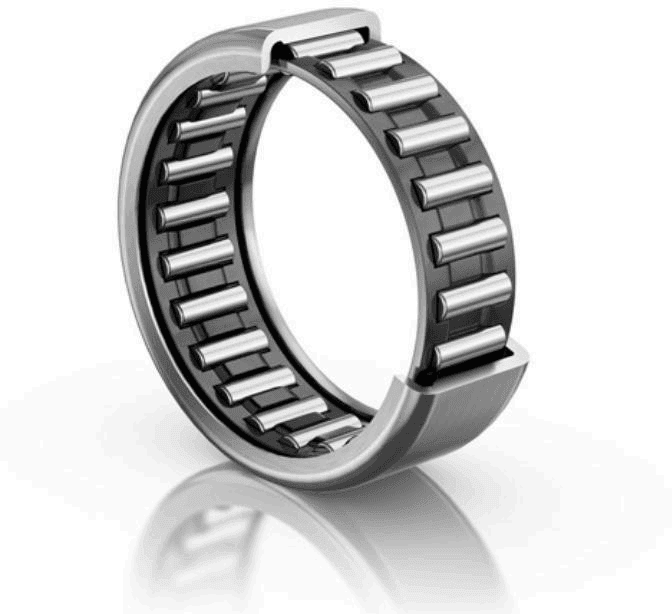
Needle roller bearings are defined by rollers with a length-to-diameter ratio exceeding 4:1. This "needle-like" geometry delivers exceptional radial load capacity within an extremely compact cross-section — the section height of a needle roller and cage assembly corresponds essentially to the diameter of the rollers themselves. In an e-axle planetary reduction gear, where the coaxial architecture forces every millimeter of radial space to fight for its existence, needle rollers provide a load rating that ball bearings of equivalent envelope simply cannot match. The radial load capacity of a needle roller bearing in a given installation space can reach 2 to 4 times that of an equivalent ball bearing.
The compactness matters for two reasons. First, it enables the overall downsizing of the e-axle unit — a smaller planetary stage means less rotating mass, which means less inertia, which means faster throttle response and marginally better efficiency. Second, the small cross-section leaves more radial room for the planet gear itself, which translates to a larger gear tooth root and higher torque capacity for the same package size. When you are designing a 150 kW e-axle that has to fit between the frame rails of a compact crossover, the bearing section height is not a specification detail — it is a packaging constraint that cascades into every other design decision.
3. Micron-Level Precision: Where Efficiency Actually Comes From
The efficiency contribution of a high-precision needle roller is not about the bearing type. It is about the tolerances to which the rollers themselves are manufactured.
Precision needle rollers used in EV transmission applications are typically ground to diameter tolerances controlled at the micron level, with surface roughness achieving Ra 0.1 μm or lower. At this level of finish, the rolling friction coefficient can be reduced to the order of 0.001. Combined with optimized raceway curvature and nano-level surface treatment technologies, energy loss through the bearing set can be reduced by 10–20% compared to standard-grade needle rollers operating in the same conditions. In the context of an EV drivetrain — where every 1% of transmission loss translates to roughly 2–3 km of range on a typical 400V battery pack — a 15% reduction in bearing friction across three planet gears is not trivial.
The precision stack works through several mechanisms simultaneously. Dimensional uniformity across rollers in a single complement ensures load sharing — if one roller is 1 μm larger in diameter than its neighbor, it carries a disproportionate share of the load, creating a localized stress concentration that accelerates fatigue and generates more heat. Roundness (circularity) control at sub-micron levels ensures that the roller does not generate harmonic vibration as it rotates under load. Surface finish eliminates the micro-asperities that generate sliding friction at the roller-to-raceway interface, which is the dominant friction mechanism in a bearing operating under boundary or mixed lubrication conditions.
Manufacturers use ISO P4/P5 class grinding technology and strict dynamic balance control to achieve these specifications. The resulting bearing exhibits significantly reduced operating vibration and maintains rotational stability even under the high-speed conditions typical of an EV motor operating near its peak power point.
NSK's high-durability needle bearing for planetary mechanisms, developed in 2013 but directly relevant to today's e-axle designs, demonstrated what precision plus optimized heat treatment can deliver: 50% more durability life and 15% more dent resistance compared to conventional bearings, with the option of either 12% downsizing or 25% weight reduction depending on design priorities. These are the kinds of trade-offs that EV transmission engineers face daily — and the bearing specification is the lever that opens up those options.
4. The Silence Problem: Why EV Transmissions Expose Bearing Noise Like Never Before
This is where the conversation shifts from mechanical engineering to acoustics, and where many first-time EV powertrain buyers discover that their bearing specification is not adequate.
In an internal combustion vehicle, engine noise covers a multitude of sins. Broadband combustion noise, valvetrain clatter, and exhaust rumble create an acoustic floor that masks gear whine, bearing rumble, and cage rattle. The driver hears "engine" and ignores everything underneath. In an EV, the acoustic floor disappears. At 60 km/h, the dominant sound sources become tire noise, wind noise — and transmission noise. The driver hears things that a bearing engineer might not have worried about ten years ago because, frankly, nobody could hear them anyway.
Needle roller bearings generate noise through several mechanisms: roller-to-raceway contact vibration, roller-to-cage impact, cage instability at high speed, and harmonic excitation from roller diameter variation. In a standard-grade bearing running at 15,000 rpm in a planetary set, these mechanisms can combine to produce a tonal whine in the 500–2,000 Hz range — precisely the frequency band where human hearing is most sensitive.
NSK recognized this problem early and developed its Silent NRB (Needle Roller Bearing) line. The key innovation is a high-precision crowning process applied to the roller ends combined with improved roundness of the roller crowning profile. The result: noise level generated by the bearing reduced to one-third of that of a conventional product. That is a sound pressure reduction of roughly 10 dB — enough to move a bearing from "audible in an EV cabin" to "below the perception threshold" under most driving conditions. These bearings are specifically targeted at electrical components mounted in vehicles with extremely quiet interiors while driving under electric motor power.
Separately, in April 2026, a Chinese manufacturer (NBR) received patent authorization for a novel stamped outer ring structure with integrated vibration and noise reduction features, specifically designed for anti-vibration and noise-reducing needle roller bearings. The patent documentation explicitly identifies electric drive systems for new energy vehicles as the primary application domain.
5. Cage Design: The Acoustic Architect Inside the Bearing
If the rollers are the load-carrying elements, the cage is the traffic controller — and in a high-speed EV transmission, bad traffic control generates noise you can measure on an NVH test bench.
The cage-guided needle roller bearing, invented by Georg Schaeffler in 1950, solved the fundamental problem that plagued earlier full-complement designs: without a cage, the long needle rollers tended to skew during rotation, moving in a transverse direction and generating substantial sliding friction between counter-rotating adjacent rollers. The cage eliminated this by maintaining precise roller spacing and parallelism, which permitted considerably higher speeds and lower friction. Schaeffler's cage-guided needle roller bearing became the foundation for compact bearing arrangements where the section height corresponds only to the roller diameter, making it indispensable for the confined spaces inside automotive transmissions.
Seventy years later, in an EV planetary gearset spinning at double or triple the speed of a conventional automatic transmission, the cage is under stresses that Georg Schaeffler never had to consider. Centrifugal force at 20,000 rpm generates radial loads on the cage pocket surfaces. Lubricant shear in the cage pocket gap generates heat. And the cage itself — typically a precision-stamped steel or polymer structure — must maintain its geometry across a temperature range that spans from -40°C cold-soak to 150°C continuous operation.
Modern high-performance cages use optimized material formulations and heat treatment to resist fatigue at elevated speeds. NTN, for example, improved the fatigue strength of its e-axle bearing cage by changing the base material, optimizing the weld geometry, and applying post-weld heat treatment — changes that collectively improved high-speed rotational performance by approximately 10%.
The cage also plays an acoustic role that is often overlooked. A cage that allows excessive roller-to-pocket clearance will generate impact noise as the roller oscillates within the pocket during each revolution. A cage that is too stiff or too tight on the roller will generate friction noise and increase bearing torque. The optimal cage design is a compromise between guidance precision (keeping the rollers parallel), clearance (allowing lubricant flow and thermal expansion), and mass (minimizing centrifugal loading). In an EV transmission, where the bearing sees highly variable speed — from zero at a traffic light to 18,000 rpm on an Autobahn on-ramp — the cage design must work across the entire operating envelope, not just at the rated speed.
6. Material and Surface Engineering: DLC, Carburizing, and Coatings
The material stack in a high-end EV transmission needle roller bearing is not "bearing steel and done." It is a sequence of deliberate metallurgical decisions, each addressing a specific failure mode that EV operating conditions amplify.
Base material. High-purity bearing steel, typically a variant of 52100 (SUJ2 in JIS nomenclature) or a case-hardening grade like SCM420, forms the substrate. The choice between through-hardened and case-hardened depends on the application: case-hardened steels provide a hard, wear-resistant surface with a tough, ductile core that resists crack propagation — important for planet gear bearings that experience occasional shock loading during regenerative braking events.
Heat treatment. Vacuum heat treatment combined with carburizing or carbonitriding processes produces a surface layer with hardness in the HRC 58–65 range while maintaining core toughness. NTN's e-axle needle roller bearing unit improved peeling resistance — a surface-initiated fatigue mode driven by thin oil films and contamination — by approximately 30% through optimization of the shaft heat treatment process.
Surface coatings. Diamond-Like Carbon (DLC) coatings represent the current frontier. Applied as a thin film (typically 1–3 μm) to the roller surface, DLC reduces the friction coefficient to approximately 0.03, effectively preventing the adhesive wear that occurs when oil films collapse under high load and low speed. This is especially relevant for EV transmissions because the trend toward lower-viscosity lubricants — driven by the pursuit of churning-loss reduction — makes boundary lubrication events more frequent. DLC acts as a safety net when the oil film is not there.
Dimensional stability. The new generation of carburizing and quenching processes, combined with vacuum-degassed steel materials, enables needle rollers to maintain stable performance across extreme environments from -40°C to 200°C. For an EV transmission that might cold-start in a Norwegian winter and then run at full power ten minutes later, thermal stability of geometry is not optional — a roller that changes diameter by half a micron due to retained austenite transformation will change its load-sharing behavior, which changes the noise signature, which shows up on the end-of-line NVH test.
7. Supplier Landscape and Sourcing Considerations
The high-precision needle roller bearing market for EV transmissions is concentrated among a handful of global suppliers who have invested in the grinding technology, quality systems, and application engineering capability required for this tier of component.
Schaeffler (INA/FAG brands) holds a dominant position, with its cage-guided needle roller bearing technology forming the basis of its e-mobility drivetrain bearing portfolio. The company explicitly positions needle roller and cage assemblies as vital components for electrified transmissions, citing their minimal design envelope and high load-carrying capacity. Schaeffler has supplied needle roller bearings for production EV programs including the Audi e-tron since 2018.
NTN has developed application-specific solutions for the coaxial e-axle architecture, including its "Needle Roller Bearing Unit for e-Axle Planetary Reduction Gear" — a pre-assembled set of needle rollers with cage and shaft, engineered as a single unit for the specific demands of planetary reduction stages. NTN improved the assembly's resistance to peeling, high-speed rotational performance, and moment load capacity through coordinated optimization of the cage, rollers, and shaft as a system rather than as individual components. The shaft material change combined with optimized roller crowning reduced shaft bending by plastic deformation by approximately 70% under moment loads.
NSK brings a distinctive acoustic specialization. Its Silent NRB product line addresses the NVH demands that become critical when transmission noise is no longer masked by engine noise. The company also has a track record of durability innovation: its high-durability needle bearing for planetary mechanisms achieved 50% longer life and 15% higher dent resistance compared to conventional designs.
For an EV program buyer, the sourcing decision is not simply about which supplier has the lowest piece price. The evaluation matrix should include: demonstrated performance in EV-relevant conditions (high speed, low-viscosity lubricant, variable load profiles); production-line traceability to the individual roller level; capability to support custom crowning profiles and custom cage geometries; availability of NVH test data under conditions that approximate the target vehicle's operating envelope; and location of production facilities relative to the assembly plant, because needle rollers are not a high-value-per-kilogram component and logistics cost can be a meaningful fraction of total landed cost.
8. The Cost of Precision: A Procurement Framework
Precision costs money. But the procurement question is not "what is the price of a P5-grade needle roller assembly versus a standard-grade one?" The procurement question is "where does the cost of a lower-grade bearing show up if we are not looking at it?"
A micron-level tolerance control, ISO P4/P5 grinding, Ra 0.1 μm surface finish, DLC coating where specified, custom cage geometry, 100% end-of-line noise testing — these features collectively add a premium to the bearing cost compared to a standard industrial-grade needle roller assembly. But the alternative — a standard-grade bearing operating at the edge of its capability envelope — generates costs that do not appear on the bearing line item.
Start with transmission efficiency. A 10% higher bearing friction across six planet gear needle roller assemblies and two shaft support bearings translates to roughly 0.5–1.0% lower transmission efficiency, which means roughly 1–3 km less range on a full charge. To recover that range through battery capacity alone costs approximately USD 8–12 per kilometer at current cell pricing. The bearing premium amortizes against that cost in the first production year.
Then there is noise. A bearing that generates audible whine at 60 km/h — even if it is mechanically flawless and will last 300,000 km — is a costly field failure in a premium EV segment, because the customer perceives it as a defect. Tearing down an e-axle to replace a set of needle rollers that are "working fine but too loud" costs significantly more than the incremental cost of specifying silent-grade bearings from the start.
Then there is durability risk. NTN's experience with peeling — surface-initiated spalling driven by thin oil films in low-viscosity e-axle lubricants — is instructive. The failure mode did not exist in the same way in conventional automatic transmissions because the lubricant viscosity was higher and the oil film was thicker. Specifying a bearing without adequate peeling resistance for an e-axle application is not a cost-saving measure; it is a durability risk that materializes as early bearing replacement, which in an integrated e-axle design can mean replacing the entire reduction gear module.
A practical cost framework for the procurement team: price the bearing at the specification the application engineer requests. Then separately price the cost of an e-axle replacement at your projected failure rate for a lower-spec bearing. Then compare the two numbers. The ratio is typically in the range of 50:1 to 200:1 in favor of the higher-spec bearing — and that is before accounting for the brand damage of a noise-related customer complaint on a vehicle where "silent operation" is a core selling proposition.
9. Frequently Asked Questions
What is the practical difference between a standard needle roller bearing and a high-precision one in an EV application?
The precision-grade bearing will have diameter tolerance controlled to within ±1–2 μm across all rollers in a single complement, surface finish of Ra 0.1 μm or better, and roundness controlled to sub-micron levels. The standard-grade bearing might have diameter variation of 5 μm across the complement and surface finish of Ra 0.2–0.3 μm. In terms of in-vehicle performance, the precision bearing will show measurably lower friction torque, lower and more consistent noise levels, and longer fatigue life under the mixed-lubrication conditions typical of low-viscosity e-axle fluids. The standard bearing will function mechanically — it will not seize or fail catastrophically at rated load — but its noise, friction, and life characteristics will be inferior.
How do I specify noise requirements for EV transmission needle rollers?
Noise specification is application-dependent and there is no single industry standard for needle roller bearing noise in EV transmissions. The practical approach is to work with the bearing supplier to define acceptable noise limits under conditions that replicate the vehicle's operating envelope — typically measured as sound pressure level (dB(A)) at a specified distance and RPM, with pass/fail criteria for tonal content in the 500–5,000 Hz band. NSK's published data on its Silent NRB shows noise reduction to one-third of conventional product levels, which provides a directional benchmark for what is achievable with current production technology.
What cage material is preferred for EV planetary needle roller bearings?
Current production is split between high-strength stamped steel cages and engineered polymer cages. Steel cages (typically case-hardened low-carbon steel) offer higher temperature capability and better fatigue resistance at sustained high speed. Polymer cages (typically glass-fiber-reinforced polyamide, PA66-GF25 or similar) offer lower mass, lower friction against the rollers, and inherent damping that can improve acoustic performance. The trend in high-speed EV applications is toward polymer cages for planetary positions and steel cages for shaft support positions where temperatures are higher, but this is a generalization and specific applications may require different choices. NTN's approach of changing cage material and optimizing weld geometry for the e-axle application suggests that the answer is not a fixed rule.
Are ceramic needle rollers viable for EV transmissions?
Silicon nitride (Si₃N₄) rolling elements are established in high-speed ball bearing applications, particularly for motor shaft support bearings in EVs, where the lower density reduces centrifugal loading at 20,000+ rpm and the electrical insulation properties prevent bearing-current damage. For needle rollers, however, ceramic is not yet a mainstream production option. The slender geometry of a needle roller makes it inherently more vulnerable to bending and edge loading, and ceramics' low fracture toughness creates a risk profile that most EV programs are not yet willing to accept for planetary gear positions. Research is ongoing, but for current production programs, high-precision steel with advanced coatings (DLC or similar) represents the practical state of the art.
How does the EV lubricant trend toward lower viscosity affect bearing specification?
Lower-viscosity lubricants reduce churning losses in the gear mesh, which improves overall transmission efficiency. But they also reduce the elastohydrodynamic (EHL) oil film thickness in the bearing contacts, which increases the frequency and severity of boundary-lubrication events. The bearing specification must compensate: higher surface finish on rollers and raceways to reduce asperity contact; surface coatings (DLC) or surface hardening treatments to resist adhesive wear; and potentially a revised cage design that maintains adequate lubrication flow to the roller-to-cage pocket interface. NTN's documentation of the peeling failure mode in coaxial e-axles — driven by "less viscous lubricating oil" that "causes the raceway surface and rolling elements to come into direct contact" — is a clear statement that the lubricant trend has direct bearing specification consequences.
10. Final Word
A needle roller in an EV transmission is small enough to lose on a workbench. Yet it lives at the intersection of three of the most demanding performance criteria in modern automotive engineering: efficiency, silence, and durability — all delivered in a package that costs a fraction of what the gears and shafts around it cost.
Get the bearing specification right, and it becomes invisible. The transmission runs quietly, the range numbers hit their targets, field service claims stay low, and nobody in the program management team ever has a meeting about needle rollers. Get it wrong, and it announces itself — through an NVH signature that the customer hears, through a friction loss that shows up in homologation testing, or through a durability issue that surfaces three years into service.
The specification that delivers "right" is not the one that works for a standard industrial gearbox. It is the one that accounts for EV-specific conditions: high speed, low-viscosity lubricant, zero engine masking noise, and a customer expectation of silence that redefines what "acceptable bearing noise" means. That specification is available from the major global bearing suppliers. It costs more than a standard-grade bearing. The cost is justified by the alternatives.
Precision at the micron level, measured in microns, priced in cents per roller, pays for itself in kilometers of range and in the absence of noise complaints — two metrics that every EV program manager tracks with religious attention. The needle roller does not ask for much attention. But it deserves the right specification.